
I’ve been in Guatemala for approximately 12 days, and I have been some kind of sick for roughly 10 of those. At first, the pollution and smoke pierced my lungs with the particulates somewhere in the range of 155 on the air quality index. Locals and tourists alike complained of headaches and difficulty breathing.
Guatemala has suffered from lots of forest fires over the past few months with much of the northern part of the country still actively burning. The smoke mixed with the heavy levels of pollutants in the air caused schools to close for three days in February.
Moving into April and May, the country saw no rain. Rain helps clear the particulates from the air and is critical to sustaining the fragile agriculture here. With no rain, there is no coffee, no bananas, no rice, and with no products, the prices increase on nearly everything. You can imagine the impact this has on the already perilous economy, not to mention the effect on the air quality.
When Jacob and I arrived on May 26, the temperature soared in the upper 80s (very hot for this time of year), with humidity above 90 percent and the particulates above 2.5pm, which is more than eight times the WHO guideline value.
Outdoor air pollution is one of the world’s largest health and environmental problems, and is the third highest risk factor for death globally, following only high blood pressure and smoking. This type of pollution is also one of the leading contributors of global disease burden, which reduces the quality of life while someone is living and shortens their lifespan significantly.
Globally, death rates from air pollution are falling, however the contributing factor in this is increased indoor air quality. For anyone who has traveled to a developing country, or Guatemala in particular, it is hard to imagine how this would have an effect when nearly the entire community lives in the liminal space between inside and outside. Rarely does a school, home, restaurant or business have fully sealed doors or windows. In fact, the majority of businesses have more outdoor space than indoor space.
I’m not saying it is a myth that the air quality is improving—I actually don’t have the data or the degree to say one way or the other—but I am asserting that even if the air quality is improving in parts of the country (likely the affluent areas), it is far from healthy for most of the families we know through Escuela Integrada.
While it has been difficult at times to feel like we could take one solid, sustainable breath, we experience this for such a short time and then have the freedom to leave and return to a place with cleaner air. The people here do not have the same opportunity, purely by nature of where they were born.
Over the last couple weeks, I’ve wrestled with this idea, along with hoping and praying for my stomach to settle and my lungs to clear. I’ve asked God on several occasions why He continues to draw me back here, only to be quickly affirmed when Eunice or Jairo run up to give me a hug at the school.
I stepped into a week of Spanish classes feeling like I knew nothing once again, and the afternoons required rest, more rest than I would have hoped for. Each day involved a discernment of, “how much can I take on today and how much do I need to rest?,” with several times where Jacob stepped in to decide that rest is what I needed more than activity. God bless my incredible husband for the ways he cares for me in my most stubborn moments.
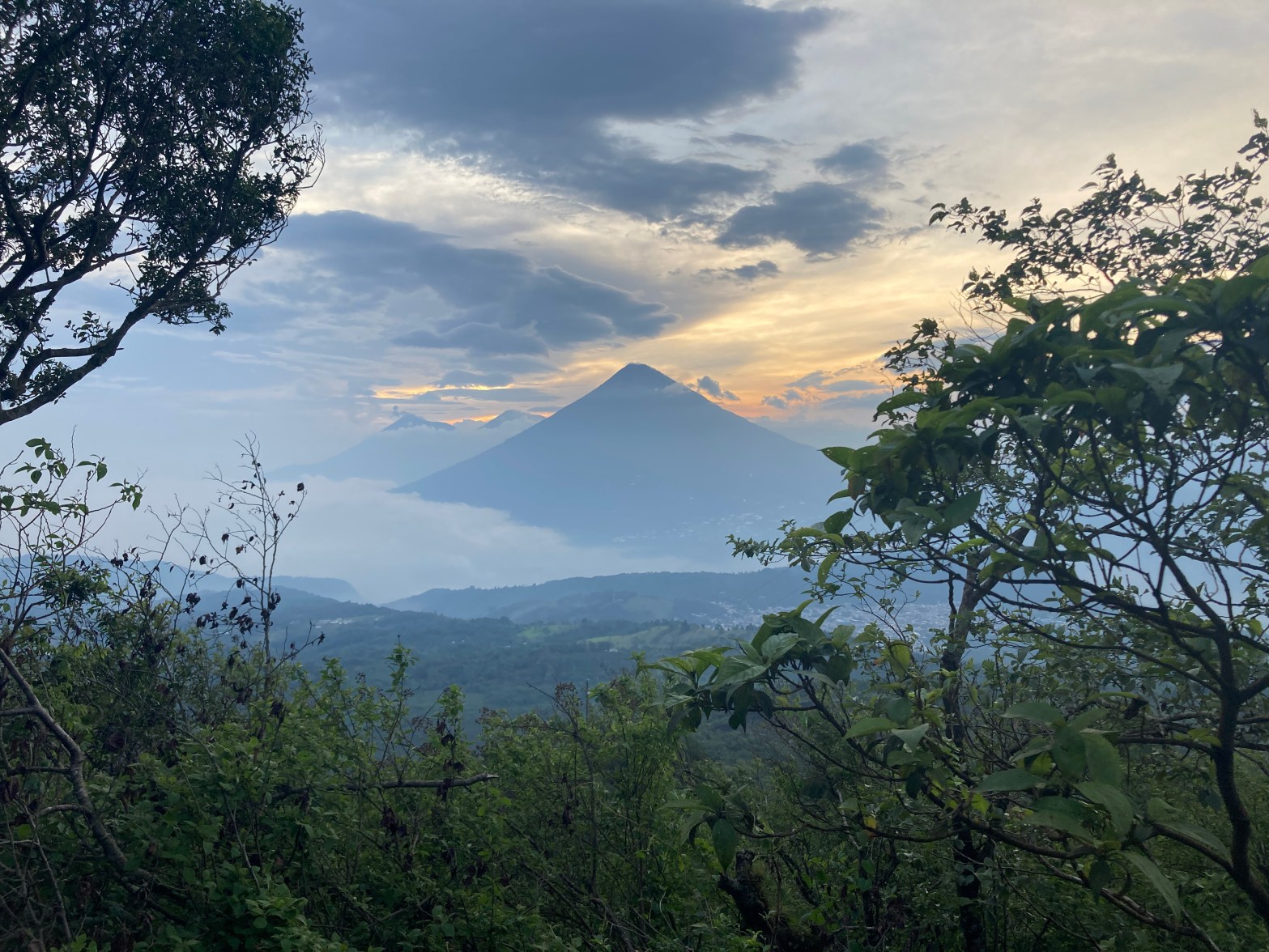
With a still-fragile stomach and who knows what else going on in my body, we decided to climb the Pacaya volcano, just south of Antigua. The hike is manageable for anyone who enjoys hiking, but the drive to get there is rough. Car sickness washed over my whole body on the drive there and on the drive back, with winding roads and smoke enveloping the car on the backside of the Agua volcano from the smoldering fires.
Arriving at the base of the volcano, I questioned whether or not it was a good idea to begin the climb, but I pressed on slowly, one step at a time. When we passed through the cloud forest beyond the treeline, the sky opened up to reveal the clearest and cleanest air we had experienced up to that point. The views were spectacular and the air fresh, a moment I craved since landing in the country six days prior.
As we entered our second week, and approximately two whole days before Jacob left, it rained. We immediately thanked the Good Lord Above for the gift of the rain. You could almost feel in a tangible way the gratitude emanating from the streets, with each passerby saying “Gracias a Dios,” (Thanks be to God) and “una bendición” (a blessing). We walked home in the rain, letting it drench us to the core, and we slept through the night for the first time since we arrived.
The rest of Jacob’s time here flew by with one day to explore and visit the places we hadn’t yet been to, and the next, a day full of preparing for the forthcoming Vision Trips with likely the biggest grocery run we’ve ever been on in Chimaltenango.
Jacob went back to the U.S. on Thursday, and discovered a newfound appreciation for air conditioning and clean air. Here in Guatemala, it has rained every day since he left, for which I am incredibly grateful. I also finally gave in and took some antibiotics.
In my women’s group this week, we studied the concept of Christian charity. Charity in this definition is not the same as the U.S. concept of charity. It has nothing to do with a physical place or a donation of goods. It has everything to do with the type of love that we show to others:
“The love which is charity is given to us from God, but living it doesn’t come easily. It dirties our hands and tires our backs with physical and emotional heavy lifting. It looks like Jesus Who loved by touching, feeling and healing people, and eventually dying for them. Charity expects a lot from us.”
It is the kind of love that sacrifices self.
Spending time in Guatemala can be incredibly hard on body and spirit, and this trip has been no exception. But it is also a call to something beyond self, something much higher and more profound. It is an opportunity to unite our suffering with the suffering of Christ, and the pain He must feel every single day knowing His people live in such abhorrent conditions.
Rarely in the U.S. do we embrace discomfort. We usually have something readily available to sedate the feeling, whether it comes in the form of physical, emotional or spiritual discomfort. Fill it with distraction, numb it with substance, escape the environment—we have so many opportunities to abandon discomfort when perhaps discomfort can be our best teacher.
I’ve been reminded more than once during the past two weeks that charity expects a lot from us. There is beauty in recognizing that every moment of discomfort is an opportunity to connect with the reality of the lived experience here. The days my lungs feel the pain of pollution is nothing compared to the lifelong impact of an elevated air quality index in a developing country, and my bubbling stomach is but a fraction of what it feels like to go without food or clean water day after day after day.
This afternoon, a Vision Trip group arrives from Ardmore, Oklahoma. For many of them, it’s their first time in a developing country. They will see things they’ve never seen before, and their lives will likely be impacted in a significant way. If you are a praying person, please pray for their awareness and understanding, and that they might willingly embrace a little discomfort during their time here.
Charity expects a lot from us.
-The Faithful Writer

 The Faithful Writer