
It was not you who chose me, but I who chose you and appointed you to go and bear fruit that will remain, so that whatever you ask the Father in my name he may give you. This I command you: love one another.”
—John 15:16-17I’ve been in Guatemala for about three-and-a-half weeks now with the last two weeks occupied with two different mission teams from the U.S.
One of the most meaningful experiences for visitors is when we take the groups on home visits. The amount of time can vary from 20 minutes to a couple of hours depending on the type of visit. The families welcome the visitors—most of whom they’ve never met—into their homes of humble existence. I’ve written about home visits before, but I want to tell you about one experience in particular from the last couple weeks.
Maria* lives in Vista Hermosa, which is the village up the hill behind Escuela Integrada. She used to be in school at Escuela Integrada, and she charmed every single visitor to our school with her bright beautiful smile and rambunctious energy. She was a frequent escape artist, leaving her classroom and frustrating her teacher I’m sure.
We did several home visits to her house during the first couple years I was involved. I have a ton of pictures of her with groups, at her house and just because she decided to be out of the classroom for more time than was necessary.
Unfortunately, she wasn’t able to stay in school. She left before the pandemic and we hadn’t seen or heard much from her or her family since.
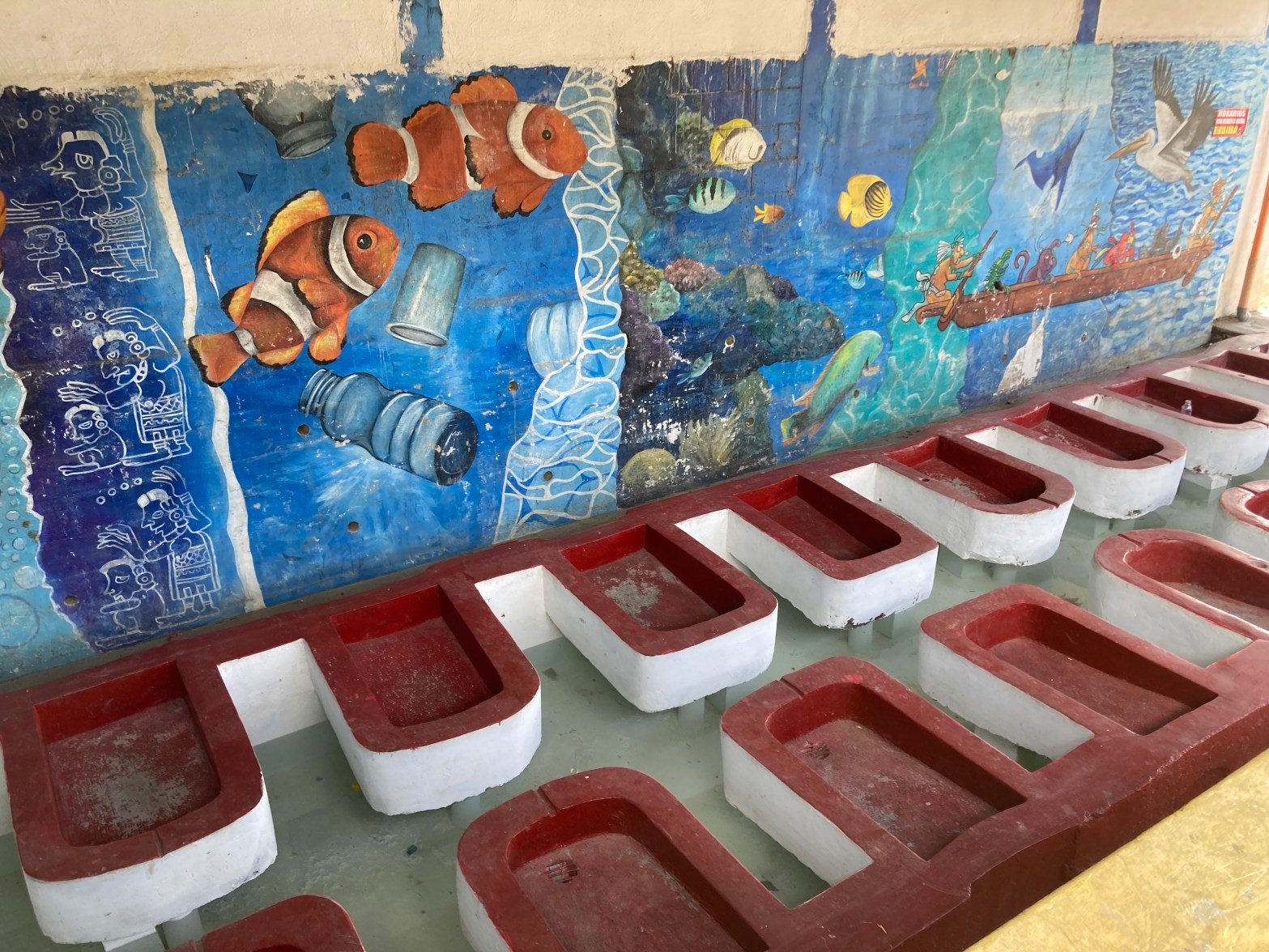
Fast forward to two Fridays ago. The mission team that was here from North Carolina had some mobility concerns so we decided to do their home visit at the pilas in Vista Hermosa instead of climbing the steep hill to their home. The pilas are a public washing station usually in the center part of each village where anyone can come clean their clothes. Vista Hermosa’s pilas happen to be right next to a big soccer field, which is near our school.
We sat on the pilas with some village perros hanging out at our feet as the small group visited with a family they support. The girl they sponsor is in 7th grade at the school and lives with her aunt and cousin. Her dad works in another town about four hours away and her mom died two years ago. The hardest part of home visits is hearing about the hardships of the families and all of the trauma they’ve faced.
About halfway through our time with the family, I saw out of the corner of my eye a familiar face, a little older and a little taller, but with the same round face. Maria. She was peering around the corner of the pilas, maybe because she recognized us.
I went up to her and, in my broken Spanish, asked her if she remembered me. I told her I remembered her from her time in kindergarten and first grade at Escuela Integrada, and I showed her pictures of herself from when she was a little girl.
Maria is now 14 years old and, from what we know, hasn’t studied since she left Escuela Integrada. Her clothes were covered in dirt, and she didn’t have the same bright smile anymore. We asked her what she was doing now, and she pointed to a group of intoxicated men.
“I work for them,” she said.
“Doing what?” we asked.
“Moving rocks and whatever else they ask me to do,” she answered.
It was 10 o’clock in the morning and the men she worked for were hammered. The same guys had passed by about an hour earlier whistling and trying to distract our small group from their home visit. “Ayeeeee, holaaaaaa mamita.” Gross. I ignored them and told the group to do the same. Stupid borrachos.
I never imagined that one of our students was working for them. Move a rock, take a shot, move a rock, take a shot, drunk day laborers. They cackled and called toward our group and kept a very close eye on Maria.
My heart broke.
She clung close to us for the next five or so minutes while we asked her a couple more questions. Then we had to leave.
I told some people at the school that we had seen her and asked if they knew anything about what was going on in her life. Were her parents working? Did she or her brother have any further education? Did her parents know that she was caught up in this situation? Even worse, did she have to be in this situation in order to help her family survive? No one really knew anything. I assumed the worst.
My boss asked if I got Maria’s phone number or if there was any way the school could reach out to her or her parents. I hadn’t thought quickly enough to ask for her number before we left. We resigned ourselves to the fact that we may never see her again.
This past Thursday, we filmed a video for Escuela Integrada and went back to the same soccer field in Vista Hermosa to film a segment where I pretended to play tennis. The same stupid borrachos were there. “Holaaaa, hellooooo, buenos diaaaaass.” They were the last people I wanted to see.
Not even 20 seconds later, Maria came running up to us. I didn’t see what direction she came from, but I’m so grateful she did—a beautiful God moment.
She didn’t have any shoes on, just socks, and her clothes were covered with grime and dust. But she smiled when she saw us. We were able to walk with her away from the men, and quietly, my boss in much more fluent Spanish asked a couple of quick questions and got a phone number to follow up with her.
Maria asked to play with my tennis racquet. She and three little boys laughed. For a moment, they got to be kids again before going back to work moving rocks.
There are some days where reality comes crashing into your face in ugly truths, like the fact that some of our students won’t be able to break the cycle of poverty.
We did another home visit for a girl who is in third grade at Escuela Integrada. Her mom had also been a student at the school, but never finished. Neither did the mom’s five other siblings. They all stopped going to school sometime in each of their middle school years to work, or because there was no transportation, or because a family member was sick and needed help.
Education is the way out of poverty here. When kids don’t finish school, their options are severely limited and often reduced to day labor for next-to-nothing. Even if we can get them through ninth grade, they have a better chance at a brighter future.
Working in poverty is hard. We have both success stories and downright tragedies.
But there is still hope.
The same day we filmed the video—and saw Maria—I was walking through town on the way to meet some friends for dinner, and I passed by a coffee shop where one of our former students works. She finished school at Escuela Integrada and continued on to earn her high school degree. With that she was able to obtain a steady job with consistent income and is slowly making changes in her family.
I also frequently run into another student at the restaurant where he works. He finished school, went to high school and now is a manager at a popular place to eat in Antigua. A couple weeks ago, he came to Family Night with his younger brother who is in 8th grade at Escuela Integrada. One step at a time, his family’s economic situation is changing. With each kid who goes through school, it gets a little bit better, and the family can see a little bit more hope.
This is why we do what we do here. This is why I come back year after year. God is working in big ways, and if I can be but a tiny instrument in His grand adventure, what an incredible gift this life is.
With a little less than a week left in my time here, there is a lot happening in my heart, some of which I understand and some that will reveal itself in the coming months. For now, I’ll keep praying for the students at Escuela Integrada and for strength for the missionaries who live this work every single day. And, I’ll leave you with this perspective on suffering and hope:
“Therefore, we are not discouraged; rather, although our outer self is wasting away, our inner self is being renewed day by day. For this momentary light affliction is producing for us an eternal weight of glory beyond all comparison, as we look not to what is seen but to what is unseen; for what is seen is transitory, but what is unseen is eternal.” —2 Cor 4: 16-18
—The Faithful Writer
*Name has been changed to protect the student’s identity
We are not discouraged

 The Faithful Writer